Welcome to BioStudy Flashcard Mode
Your interactive companion for mastering Biology concepts
About This Reviewer
This interactive reviewer covers the complete Meiosis curriculum from General Biology 1. It's designed to help you memorize and understand complex biological concepts through active learning.
Features
- 18 comprehensive modules following your exact PDF structure
- Images extracted directly from course materials
- Memory aids and mnemonics for difficult concepts
- Practice quizzes with instant feedback
- Mastery tracking to monitor your progress
Two Study Modes
Normal Mode
Default reading experience
- Read all content with highlighted keywords
- View images and diagrams
- Take practice quizzes
- Best for: First-time learning
Flashcard Mode
Active recall practice
- Content hidden - only flashcards shown
- Each lesson has multiple flashcards
- Includes throwback questions from previous topics
- Best for: Reviewing before exams
How to Use Mastery Tracking
Each topic has 3 stars. Click the stars to track your progress:
Mastery Levels
- 1 Star - I've read this topic
- 2 Stars - I understand the concepts
- 3 Stars - I've mastered this (quiz passed!)
Getting Started
- Start with Normal Mode and read through each topic
- Click the stars to mark your progress as you go
- Take the quick quizzes at the end of each section
- Switch to Flashcard Mode to test your memory with flashcards
Keyboard Shortcuts
- Ctrl + M - Cycle through study modes
Meiosis - Complete Reviewer
General Biology 1 | Prepared by: Yuan S. Masuda, RCh | Augustinian Abbey School
Overview
Memory Aid
Genetics - Scientific study of heredity and variation
Heredity - Transmission of traits from one generation to the next
Variation - Differences in appearance that offspring show from parents and siblings
Key Concepts
- Genetics - Scientific study of heredity and variation
- Heredity - Transmission of traits from one generation to the next
- Variation - Demonstrated by the differences in appearance that offspring show from parents and siblings
Important Point
In a literal sense, children do NOT inherit particular physical traits from their parents. Rather, it is genes that are inherited.
Flashcard Practice
Click each card to reveal the answer - test your memory!
What does GHV stand for in Genetics?
Click to flip
GHV
Genetics - Scientific study of heredity and variation
Heredity - Transmission of traits from one generation to the next
Variation - Differences in appearance between offspring and parents
What do children actually inherit from their parents?
Click to flip
Genes, Not Traits!
Children do NOT inherit physical traits directly.
They inherit genes, which then code for those traits.
Define: Genetics
Click to flip
Genetics
The scientific study of heredity and variation.
Define: Heredity
Click to flip
Heredity
The transmission of traits from one generation to the next.
Define: Variation
Click to flip
Variation
Differences in appearance that offspring show from parents and siblings.
Quick Quiz
Inheritance of Genes
Genes and Heredity
Genes
- Units of heredity
- Made up of segments of DNA
- Passed to the next generation through gametes (sperm and eggs)
Key Terms
- Locus (plural: loci) - Specific location of a gene on a chromosome
- Most DNA is packaged into chromosomes
- One set of chromosomes is inherited from each parent
Memory Aid
Think of a locus as the "address" of a gene on a chromosome
Flashcard Practice
Click each card to reveal the answer - test your memory!
What is a locus?
Click to see answer
Locus
The specific location of a gene on a chromosome
Mnemonic: Locus = Location
What are genes made of?
Click to see answer
DNA Segments
Genes are segments of DNA that code for specific traits.
How are genes passed to the next generation?
Click to see answer
Via Gametes
Genes are passed through gametes (sperm and egg cells).
What is the plural of locus?
Click to see answer
Loci
The plural of locus is loci.
⏮ THROWBACK
What does GHV stand for?
From: Overview
GHV
Genetics | Heredity | Variation
Quick Quiz
5. What does GHV stand for?
Sets of Chromosomes in Human Cells
Human Chromosome Numbers
Key Facts
- Human somatic cells have 23 pairs of chromosomes
- Karyotype - Ordered display of the pairs of chromosomes from a cell
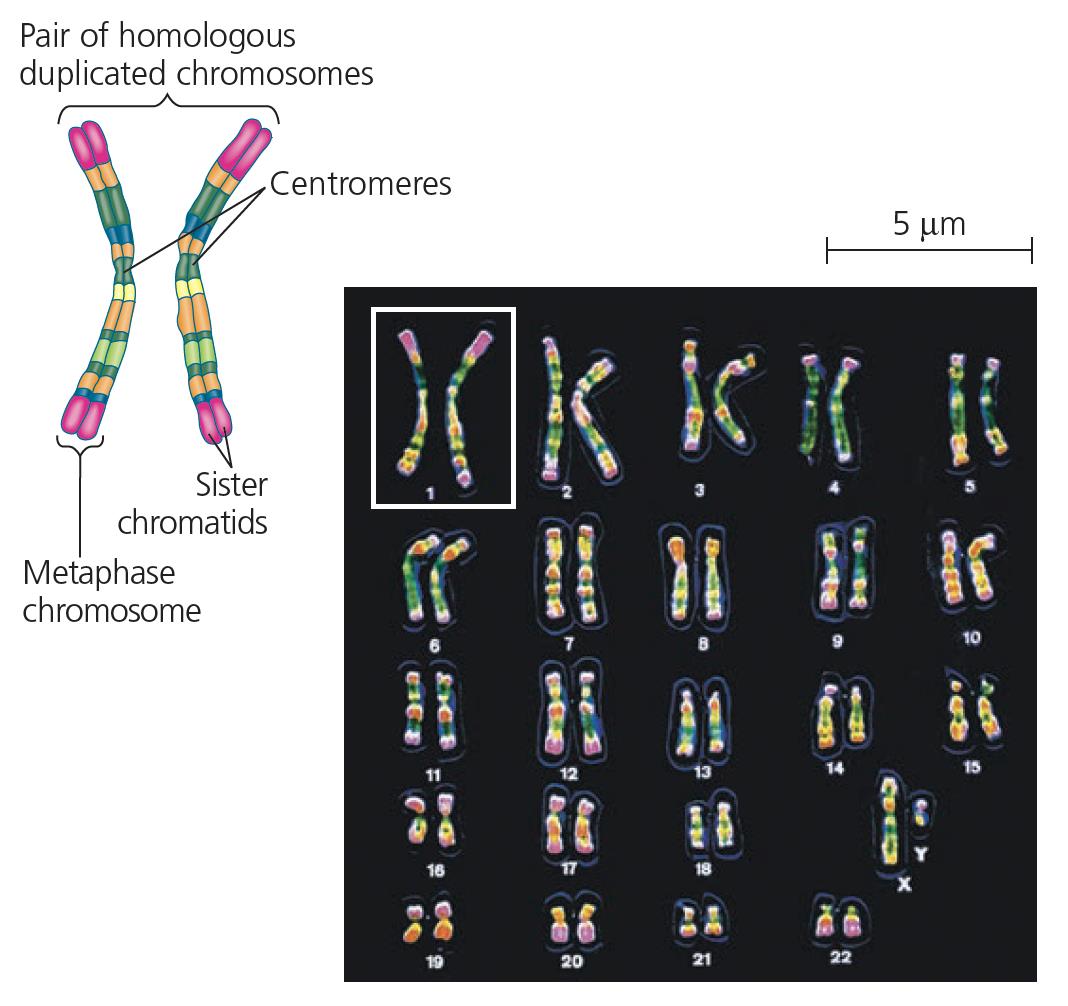
Homologous Chromosomes
Pairs of chromosomes, one from each parent. Each have the same length and carry genes controlling the same inherited character.
Important Note: They are NOT IDENTICAL - they have the same genes but may have different alleles.
2 Sex Chromosomes (1 Pair: XX or XY)
Flashcard Practice
Click each card to reveal the answer - test your memory!
How many chromosomes do humans have?
Click to see answer
46 Chromosomes
23 pairs = 46 total
44 autosomes + 2 sex chromosomes (XX or XY)
How many pairs of chromosomes do humans have?
Click to see answer
23 Pairs
Humans have 23 pairs of chromosomes
Each pair consists of one chromosome from the mother and one from the father
What are autosomes?
Click to see answer
Autosomes
Autosomes are non-sex chromosomes
Humans have 22 pairs of autosomes (44 total)
They carry genes for most body characteristics
What are the sex chromosomes in humans?
Click to see answer
X and Y Chromosomes
Humans have 1 pair of sex chromosomes (2 total)
XX = Female | XY = Male
These are the 23rd pair and determine biological sex
How many autosomes vs sex chromosomes?
Click to see answer
44 Autosomes + 2 Sex Chromosomes
44 autosomes = 22 pairs of non-sex chromosomes
2 sex chromosomes = 1 pair (XX or XY)
Total: 46 chromosomes in somatic cells
THROWBACK
What do children actually inherit from their parents?
From: Overview
Genes, Not Traits!
Children do NOT inherit physical traits directly
They inherit genes, which then code for those traits
Quick Quiz
5. What do children actually inherit from their parents?
Homologous Chromosomes
Understanding Homologous Chromosomes
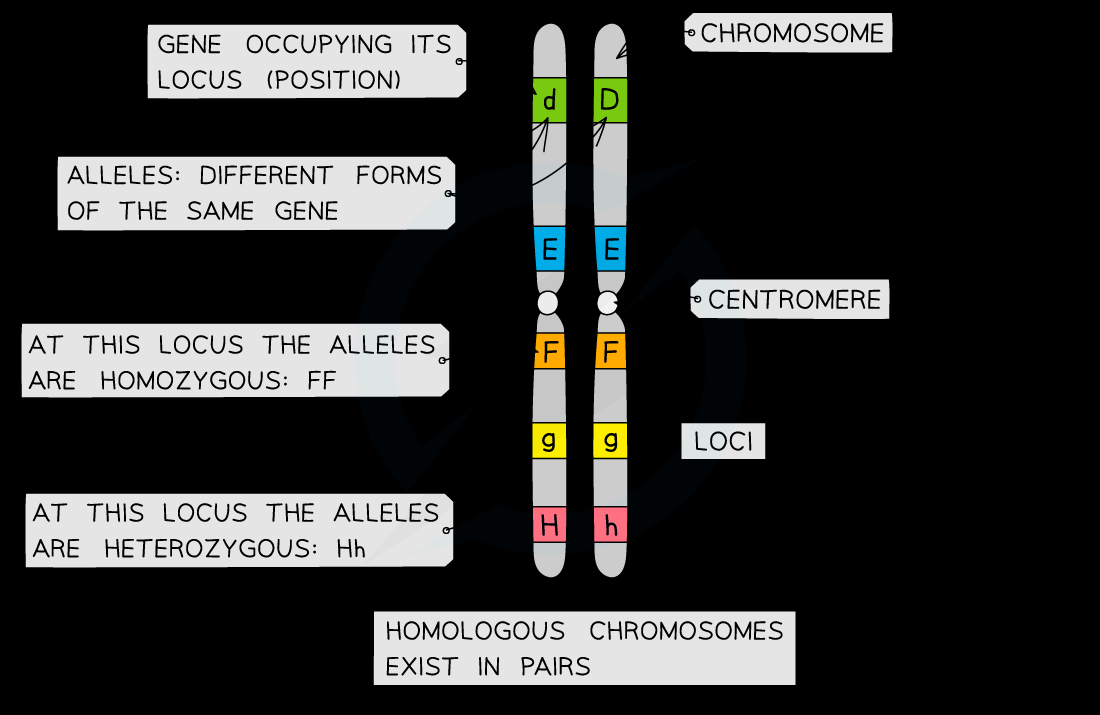
Homologous Chromosomes
Chromosome pairs (one from each parent) that have:
- The same length
- The same centromere position
- Genes controlling the same inherited characters
Homologous vs. Sister Chromatids
| Feature | Homologous Chromosomes | Sister Chromatids |
|---|---|---|
| Source | One from each parent | Identical copies from same parent |
| Genetic content | Same genes, different alleles possible | Genetically identical |
| Connection | Paired during meiosis | Joined at centromere |
Flashcard Practice
Click each card to reveal the answer - test your memory!
What are homologous chromosomes?
Click to see answer
Homologous Chromosomes
Chromosome pairs with:
- Same length
- Same centromere position
- Same genes (but possibly different alleles)
- One from each parent
Are homologous chromosomes identical?
Click to see answer
NO!
Homologous chromosomes are NOT IDENTICAL
They have the same genes but may have different alleles
Think: Same recipe book, different editions!
What do homologous chromosomes share?
Click to see answer
Same Characteristics!
Homologous chromosomes have:
Same length | Same centromere position | Same genes
They control the same inherited characters (like eye color, blood type)
Where do homologous chromosomes come from?
Click to see answer
One From Each Parent
In each homologous pair:
One chromosome from the mother (maternal)
One chromosome from the father (paternal)
What's the difference between homologous chromosomes and sister chromatids?
Click to see answer
Source and Genetics!
Homologous chromosomes: One from each parent, different alleles possible
Sister chromatids: Identical copies from the SAME parent
Homologs pair during meiosis; sisters are joined at centromere
THROWBACK
What is a locus?
From: Inheritance of Genes
Locus
The specific location of a gene on a chromosome
Mnemonic: Locus = Location
Quick Quiz
5. What is a locus?
Diploidy and Haploidy
Chromosome Sets: n, 2n
n = Number of chromosomes in a single set
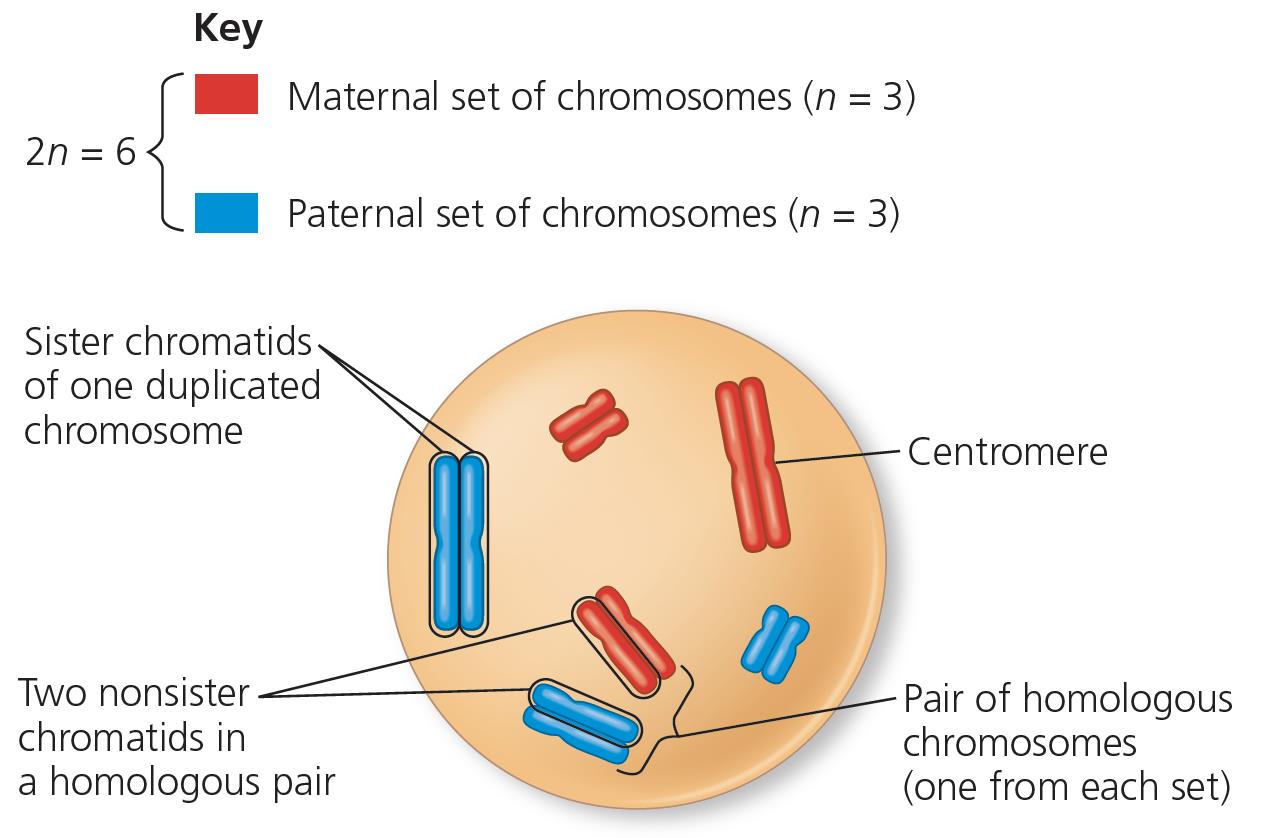
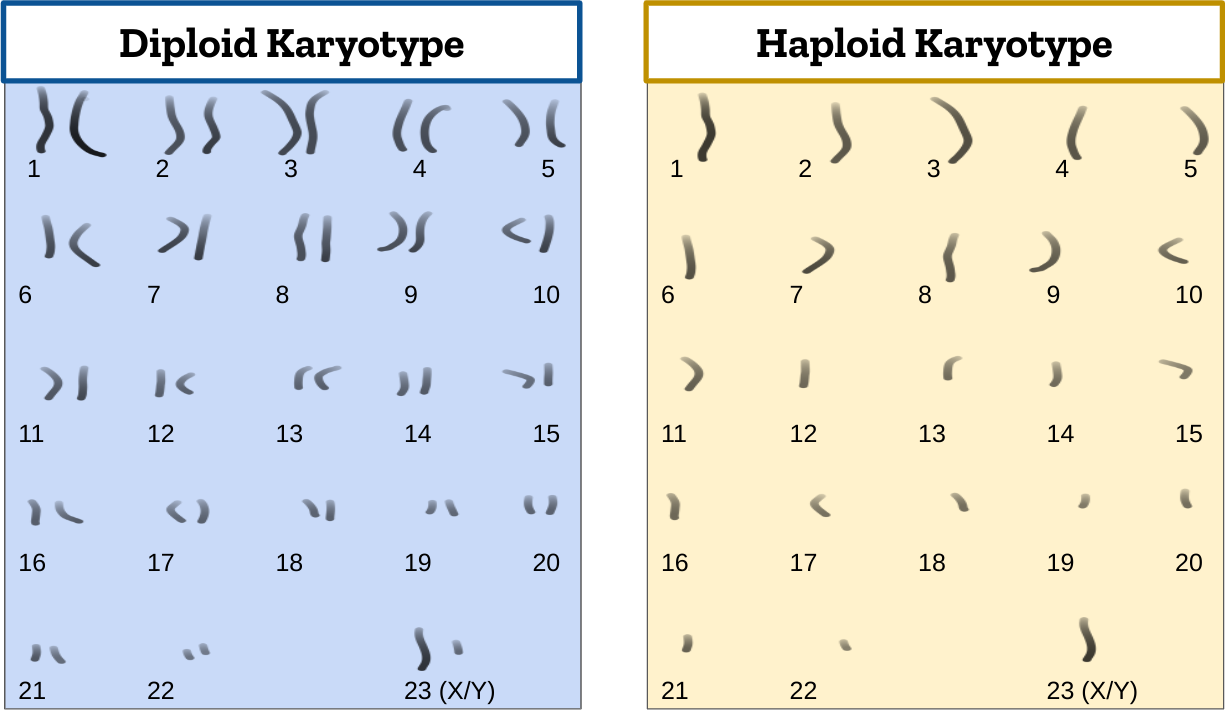
| Feature | Diploid Cell (2n) | Haploid Cell (n) |
|---|---|---|
| Chromosome sets | Two chromosome sets | One chromosome set |
| Cell type | Somatic cells (body cells) | Gametes (sex cells) |
| Human number | 46 (2n = 46) | 23 (n = 23) |
Memory Aid
2n = Diploid = Two sets (body cells)
n = Haploid = One set (gametes)
Flashcard Practice
Click each card to reveal the answer - test your memory!
What's the difference between 2n and n?
Click to see answer
Diploid (2n) vs Haploid (n)
2n = Diploid = Two sets of chromosomes (somatic cells) = 46 in humans
n = Haploid = One set of chromosomes (gametes) = 23 in humans
Mnemonic: DIploid = Double, HAploid = HA lf
What does "2n" represent?
Click to see answer
Diploid (2n)
2n = Diploid means two sets of chromosomes
Found in somatic cells (body cells)
In humans: 46 chromosomes (23 pairs)
What does "n" represent?
Click to see answer
Haploid (n)
n = Haploid means one set of chromosomes
Found in gametes (sex cells: sperm and eggs)
In humans: 23 chromosomes (unpaired)
What type of cells are diploid?
Click to see answer
Somatic Cells (Body Cells)
Somatic cells are diploid (2n)
Examples: skin cells, nerve cells, muscle cells, blood cells
They contain two full sets of chromosomes
What type of cells are haploid?
Click to see answer
Gametes (Sex Cells)
Gametes are haploid (n)
Examples: sperm cells and egg cells
They contain only one set of chromosomes
THROWBACK
How many autosomes do humans have?
From: Sets of Chromosomes
44 Autosomes
Humans have 22 pairs of autosomes = 44 total
Autosomes are non-sex chromosomes
Quick Quiz
5. How many autosomes do humans have?
Sex Chromosomes
Determining Biological Sex
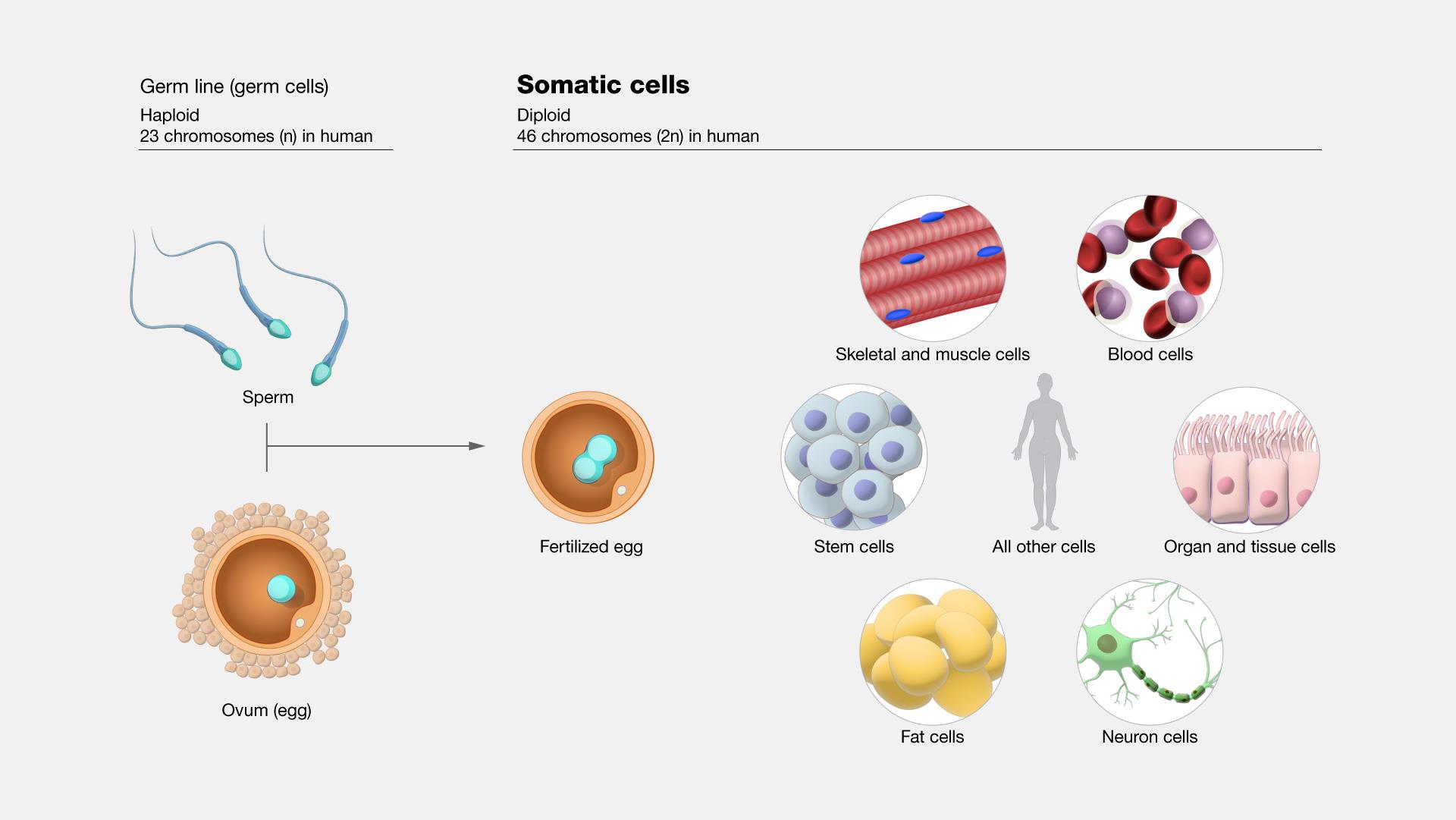
Key Facts
- Unfertilized ovum (egg) contains an X chromosome
- Sperm contains either an X or a Y chromosome
| Parent | Sex Chromosomes | Gametes Produced |
|---|---|---|
| Mother (female) | XX | All eggs contain ONE X chromosome |
| Father (male) | XY | Half of sperm have X, half have Y |
Flashcard Practice
Click each card to reveal the answer - test your memory!
Who determines the baby's sex?
Click to see answer
The FATHER!
Mothers can only give X
Fathers can give X or Y
XX = Female | XY = Male
What sex chromosomes does a mother have?
Click to see answer
XX
Mothers have XX sex chromosomes
All eggs contain ONE X chromosome
Mothers can only pass on an X chromosome
What sex chromosomes does a father have?
Click to see answer
XY
Fathers have XY sex chromosomes
Half of sperm have X, half have Y
Fathers determine the baby's sex
What sex chromosome does an unfertilized egg contain?
Click to see answer
One X Chromosome
An unfertilized ovum (egg) contains an X chromosome
Mothers can only contribute X chromosomes to their offspring
What chromosome combination produces a female?
Click to see answer
XX
XX = Female
One X from mother + One X from father
THROWBACK
Are homologous chromosomes genetically identical?
From: Homologous Chromosomes
NO!
Homologous chromosomes are NOT IDENTICAL
They have the same genes but may have different alleles
Quick Quiz
5. Are homologous chromosomes genetically identical?
Behavior of Chromosome Sets: Human Life Cycle
Fertilization and the Zygote
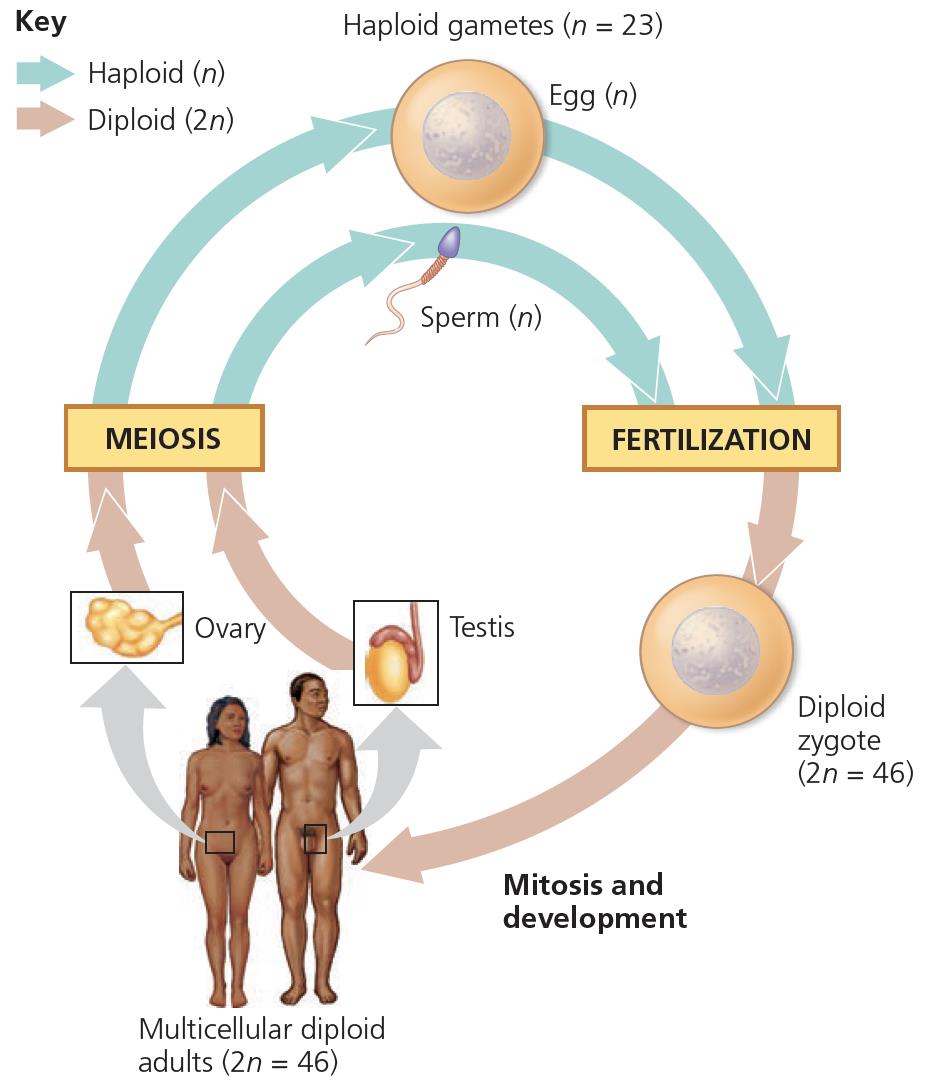
Fertilization
The union of gametes (sperm + egg)
Zygote
Fertilized ovum that is diploid. It produces somatic cells by mitosis and develops into an adult.
Gametes: Special Cells
Key Points About Gametes
- Gametes are the ONLY cells of the human body not produced by mitosis
- They develop from specialized cells called germ cells in the gonads
- Ovaries in females
- Testes in males
- They would be diploid (46 chromosomes)
- At fertilization, chromosome number would double to 92
- Each subsequent generation would double again!
- This would be incompatible with life
Flashcard Practice
Click each card to reveal the answer - test your memory!
What does fertilization produce?
Click to see answer
Zygote (2n)
Sperm (n) + Egg (n) = Zygote (2n)
23 + 23 = 46 chromosomes
What is fertilization?
Click to see answer
Fertilization
The union of gametes (sperm + egg)
This process restores the diploid condition
What is a zygote?
Click to see answer
Zygote
A fertilized ovum that is diploid (2n)
It produces somatic cells by mitosis and develops into an adult
How many chromosomes does a human zygote have?
Click to see answer
46 Chromosomes
Sperm (23) + Egg (23) = Zygote (46)
Fertilization restores the diploid number
What would happen if gametes were made by mitosis?
Click to see answer
Chromosome Number Would Double!
Gametes would be diploid (46 chromosomes)
At fertilization: 46 + 46 = 92 chromosomes
Each generation would double - incompatible with life!
THROWBACK
What type of cells are haploid?
From: Diploidy and Haploidy
Gametes (Sex Cells)
Gametes are haploid (n)
They contain only one set of chromosomes
Quick Quiz
5. What type of cells are haploid?
Meiosis
Introduction to Meiosis
What is Meiosis?
In sexually reproducing organisms, gamete formation involves meiosis. Meiosis reduces the number of sets of chromosomes from two to one in the gametes, counterbalancing the doubling that occurs at fertilization.
Key Facts
- Each human sperm and egg is haploid (n = 23)
- Fertilization restores the diploid condition by combining two sets of chromosomes
- The human life cycle is repeated
How Meiosis Works
Before Meiosis Begins (Interphase)
- Like mitosis, interphase occurs first (chromosome replication)
- Sister chromatids are genetically identical and joined at the centromere
- Single centrosome replicates, forming two centrosomes
Meiosis Has Two Divisions
- Meiosis I - Homologous chromosomes separate
- Meiosis II - Sister chromatids separate
Flashcard Practice
Click each card to reveal the answer - test your memory!
What does meiosis produce?
Click to see answer
4 Haploid Gametes
1 Diploid cell (2n) Meiosis 4 Haploid gametes (n)
For humans: 1 cell (46 chr) 4 gametes (23 chr each)
What is the purpose of meiosis?
Click to see answer
Gamete Formation
Meiosis produces gametes (sperm and eggs)
It reduces chromosome number from diploid (2n) to haploid (n)
This counterbalances the doubling at fertilization
How many cell divisions occur in meiosis?
Click to see answer
Two Divisions
Meiosis I - Homologous chromosomes separate
Meiosis II - Sister chromatids separate
Result: 4 daughter cells (not 2 like mitosis)
What happens before meiosis begins?
Click to see answer
Interphase (DNA Replication)
Chromosomes replicate during interphase
Sister chromatids are genetically identical and joined at the centromere
Centrosome also replicates
How many daughter cells does meiosis produce?
Click to see answer
FOUR Daughter Cells
Meiosis produces FOUR haploid daughter cells
Mitosis produces only TWO diploid daughter cells
All four cells are genetically unique
THROWBACK
Who determines the baby's sex?
From: Sex Chromosomes
The FATHER!
Mothers can only give X
Fathers can give X or Y
Quick Quiz
5. Who determines the baby's sex?
Stages of Meiosis
The Two Divisions of Meiosis
| Stage | What Happens | Result |
|---|---|---|
| Meiosis I | Homologous chromosomes separate | Reductional Division - two haploid daughter cells with replicated chromosomes |
| Meiosis II | Sister chromatids separate | Equational Division - four haploid daughter cells with unreplicated chromosomes |
Memory Aid
Prophase Metaphase Anaphase Telophase
Happens TWICE (Meiosis I + Meiosis II)
Flashcard Practice
Click each card to reveal the answer - test your memory!
What are the two divisions of meiosis?
Click to see answer
Meiosis I and Meiosis II
Meiosis I: Homologous chromosomes separate (reductional)
Meiosis II: Sister chromatids separate (equational)
PMAT x 2 - Prophase, Metaphase, Anaphase, Telophase happens twice!
What does PMAT stand for in cell division?
Click to see answer
PMAT
Prophase | Metaphase | Anaphase | Telophase
In meiosis, PMAT happens TWICE (Meiosis I and II)
What separates in Meiosis I?
Click to see answer
Homologous Chromosomes
In Meiosis I, homologous chromosomes separate
This is called the reductional division
Produces two haploid cells
What separates in Meiosis II?
Click to see answer
Sister Chromatids
In Meiosis II, sister chromatids separate
This is called the equational division
Produces four haploid cells
How many times does DNA replicate in meiosis?
Click to see answer
Once!
DNA replicates ONCE before Meiosis I
There is NO replication between Meiosis I and II
THROWBACK
What is a zygote?
From: Human Life Cycle
Zygote
A fertilized ovum that is diploid (2n)
Sperm (n) + Egg (n) = Zygote (2n)
Quick Quiz
5. What is a zygote?
Meiosis I
The Reductional Division - Homologous Chromosomes Separate
Meiosis I Overview
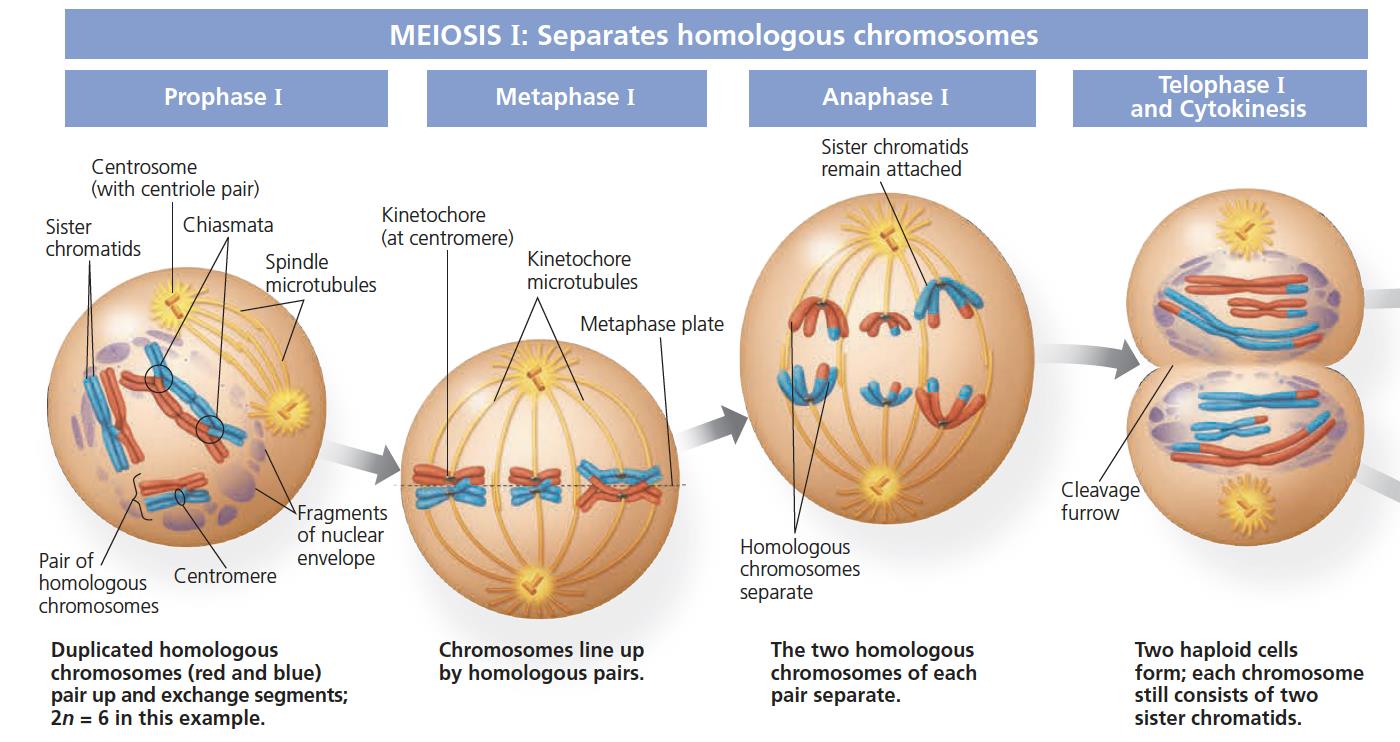
Prophase I
What Happens
- Centrosomes move, spindle fibers form, and the nuclear envelope breaks down
- Chromosomes condense and become visible
Early Prophase I
- Each chromosome pairs with its homolog
- Crossing Over happens - non-sister chromatids swap DNA at X-shaped spots called chiasmata (singular: chiasma)
Late Prophase I
- Spindle fibers attach to kinetochores on each homolog pair
- Microtubules start moving homologous pairs toward the metaphase plate
Metaphase I
Key Events
- Homologs line up at the metaphase plate
- Each homolog is connected to spindle fibers from opposite poles - one pair faces each side
Anaphase I
Key Events
- Proteins holding homologs together break, so homologs separate
- Spindle fibers pull homologs toward opposite poles
- Sister chromatids stay joined at the centromere and move together toward one side
Memory Aid for Anaphase I
Telophase I and Cytokinesis
Telophase I
- Each side of the cell has a haploid set of duplicated chromosomes (still with sister chromatids)
- Some chromatids have swapped DNA due to crossing over
Cytokinesis
- Forms two haploid cells
- Animals: cleavage (pinching in)
- Plants: cell plate formation
Flashcard Practice
Click each card to reveal the answer - test your memory!
What happens in Anaphase I?
Click to see answer
Homologs APART, Sisters TOGETHER!
In Anaphase I, homologous chromosomes separate
But sister chromatids stay JOINED together
This is why it's called the "reductional" division
What happens during Prophase I?
Click to see answer
Crossing Over!
Crossing over occurs in Prophase I
Homologous chromosomes pair up and swap DNA
X-shaped sites called chiasmata become visible
What happens during Metaphase I?
Click to see answer
Tetrads Line Up
Homologous pairs (tetrads) line up at metaphase plate
Each homolog faces opposite poles
Unlike mitosis where individual chromosomes line up
What happens during Telophase I?
Click to see answer
Two Haploid Cells Form
Each side gets a haploid set of duplicated chromosomes
Cytokinesis forms two haploid cells
NO DNA replication before Meiosis II
What is crossing over?
Click to see answer
DNA Swapping
Non-sister chromatids swap DNA segments at X-shaped chiasmata
Produces recombinant chromosomes with new allele combinations
Creates genetic variation!
THROWBACK
What does meiosis produce?
From: Meiosis
4 Haploid Gametes
1 Diploid cell (2n) 4 Haploid gametes (n)
Quick Quiz
5. What does meiosis produce?
Meiosis II
The Equational Division - Sister Chromatids Separate
Meiosis II Overview
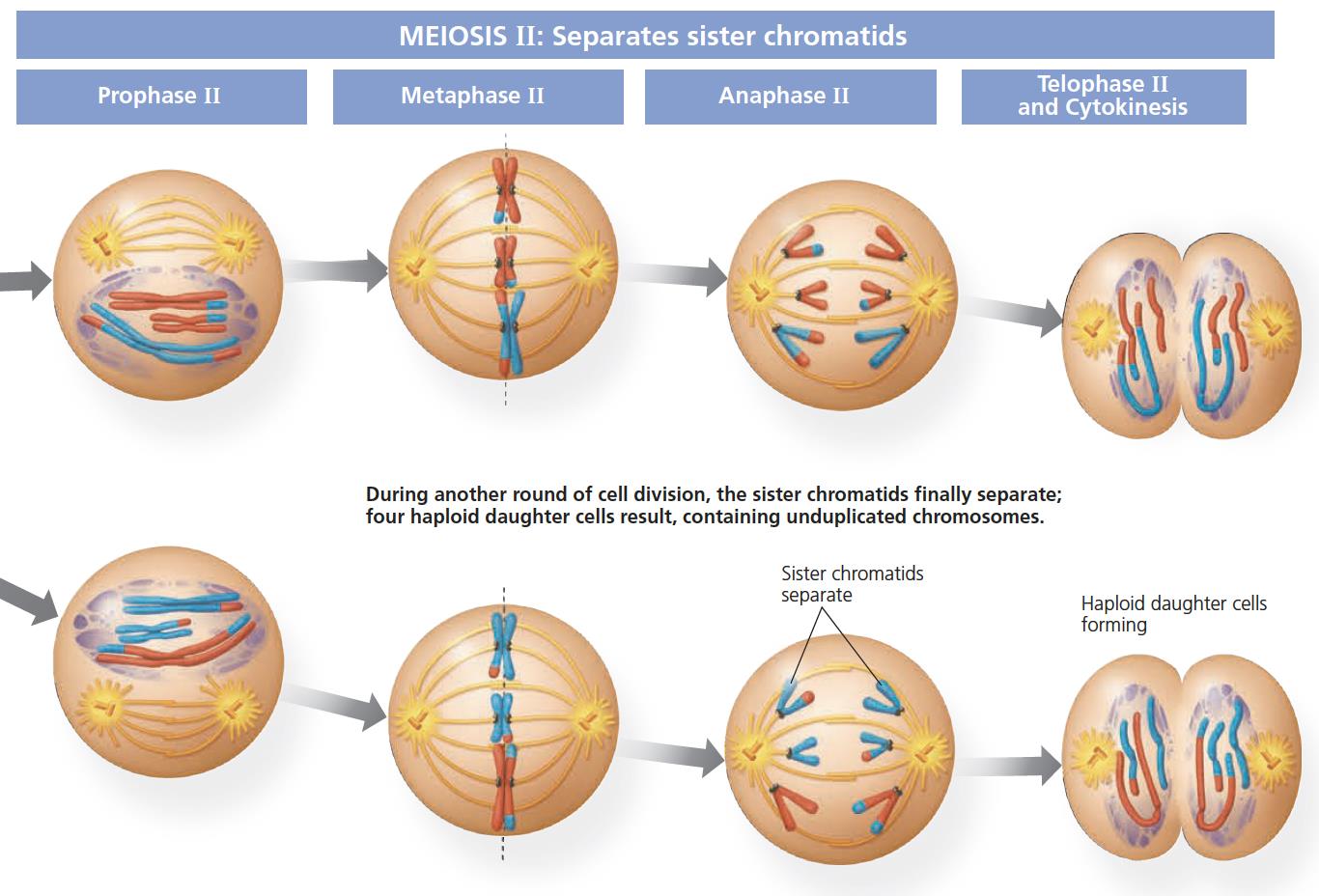
Prophase II
Key Events
- New spindle forms
- Late Prophase II - spindle fibers move chromosomes (with sister chromatids) toward metaphase II plate
Metaphase II
Key Events
- Chromosomes line up at metaphase II plate
- Due to crossing over, sister chromatids are not identical
- Each chromatid is connected to spindle fibers from opposite poles
Anaphase II
Key Events
- Proteins at the centromere break, sister chromatids separate
- Chromatids move to opposite poles, now as individual chromosomes
Memory Aid for Anaphase II
Unlike Anaphase I - now sister chromatids finally separate!
Telophase II and Cytokinesis
Key Events
- Nuclei form, chromosomes unwind
- Cytokinesis happens
- Meiosis ends with 4 haploid daughter cells, each with unduplicated chromosomes
Final Result
These cells are genetically unique from each other and from the parent cell due to crossing over and independent assortment.
Flashcard Practice
Click each card to reveal the answer - test your memory!
What happens in Anaphase II?
Click to see answer
Sisters APART!
Unlike Anaphase I - now sister chromatids finally separate!
Each chromatid becomes an individual chromosome
This is similar to mitosis
What happens during Prophase II?
Click to see answer
New Spindle Forms
A new spindle apparatus forms
Spindle fibers move chromosomes toward metaphase II plate
No DNA replication occurs
What happens during Metaphase II?
Click to see answer
Chromosomes Line Up
Individual chromosomes line up at metaphase II plate
Due to crossing over, sister chromatids are not identical
Similar to metaphase of mitosis
What happens during Telophase II?
Click to see answer
Four Haploid Cells Form
Nuclei form and chromosomes unwind
Cytokinesis happens
Meiosis ends with 4 haploid daughter cells
How is Meiosis II similar to mitosis?
Click to see answer
Sister Chromatids Separate
In both, sister chromatids separate
Individual chromosomes line up (not pairs)
But Meiosis II produces haploid cells, mitosis produces diploid
THROWBACK
What happens in Anaphase I?
From: Meiosis I
Homologs APART, Sisters TOGETHER!
Homologous chromosomes separate
Sister chromatids stay joined
Quick Quiz
5. What happens in Anaphase I?
Comparing Mitosis and Meiosis
Key Differences
| Feature | Mitosis | Meiosis |
|---|---|---|
| Purpose | Growth, tissue repair, asexual reproduction | Production of gametes for sexual reproduction |
| Where it occurs | Throughout body (somatic cells) | Only in gonads (germ cells) |
| Number of divisions | One | Two |
| Number of daughter cells | Two | Four |
| Chromosome number | Same as parent (2n) | Half of parent (n) |
| Genetic composition | Identical to parent and each other | Unique (different from parent and each other) |
| DNA replication | Occurs once before division | Occurs once before Meiosis I |
| Role in animal body | Enables body to grow & repair | Produces gametes for reproduction |
| Occurs during | Somatic cell division | Gamete formation |
Memory Aid
MITosis = Makes Identical cells (2n 2n)
MEIosis = Makes Eg/sperm & reduces (2n n)
Flashcard Practice
Click each card to reveal the answer - test your memory!
What's the main difference between mitosis and meiosis?
Click to see answer
Mitosis vs Meiosis
Mitosis: Makes 2 identical diploid (2n) cells
Meiosis: Makes 4 unique haploid (n) cells
MIT = Makes Identical Twins (genetically same)
MEI = Makes Eggs/Sperm & reduces (genetically different)
How many daughter cells does mitosis produce?
Click to see answer
Two Daughter Cells
Mitosis produces 2 daughter cells
Meiosis produces 4 daughter cells
How many divisions occur in mitosis vs meiosis?
Click to see answer
One vs Two
Mitosis: One division
Meiosis: Two divisions (Meiosis I and II)
What is the genetic composition of mitosis daughter cells?
Click to see answer
Genetically Identical
Mitosis daughter cells are identical to parent and each other
Meiosis daughter cells are genetically unique
What is the chromosome number in mitosis vs meiosis?
Click to see answer
Same vs Half
Mitosis: Same as parent (2n)
Meiosis: Half of parent (n)
Mitosis maintains chromosome number; meiosis reduces it
THROWBACK
What separates in Meiosis I vs Meiosis II?
From: Stages of Meiosis
Homologs vs Sisters
Meiosis I: Homologous chromosomes separate
Meiosis II: Sister chromatids separate
Quick Quiz
5. What separates in Meiosis I vs Meiosis II?
Three Unique Events in Meiosis
All occur in Meiosis I
Events That Only Happen in Meiosis (Not Mitosis)
1. Synapsis & Crossing Over (Prophase I)
Homologs pair up and swap DNA.
2. Tetrads at Metaphase Plate (Metaphase I)
Homolog pairs (not single chromosomes) line up at the metaphase plate.
3. Homologs Separate (Anaphase I)
Sister chromatids stay together; homologs move apart.
Flashcard Practice
Click each card to reveal the answer - test your memory!
What are the three unique events in meiosis?
Click to see answer
All in Meiosis I!
1. Synapsis & Crossing Over - Prophase I
2. Tetrads at Metaphase Plate - Metaphase I
3. Homologs Separate - Anaphase I
These NEVER happen in mitosis!
What happens during synapsis and crossing over?
Click to see answer
DNA Swapping!
Homologous chromosomes pair up (synapsis)
Non-sister chromatids swap DNA (crossing over)
Produces recombinant chromosomes - new gene combinations!
What lines up at the metaphase plate in meiosis?
Click to see answer
Tetrads (Homolog Pairs)
In Meiosis I, tetrads (homolog pairs) line up
In mitosis, individual chromosomes line up
This is unique to meiosis!
What separates in Anaphase I that's unique?
Click to see answer
Homologous Chromosomes
Homologs separate while sister chromatids stay together
In mitosis, sister chromatids separate
This reductional division only happens in meiosis!
Do all three unique events occur in Meiosis II?
Click to see answer
NO!
All three unique events occur ONLY in Meiosis I
Meiosis II is very similar to mitosis
These events never happen in mitosis!
THROWBACK
How many daughter cells does meiosis produce?
From: Meiosis II
FOUR Daughter Cells
Meiosis produces FOUR haploid daughter cells
All four are genetically unique
Quick Quiz
5. What separates during Anaphase II?
Synapsis and Crossing Over (Prophase I)
The Process Step by Step
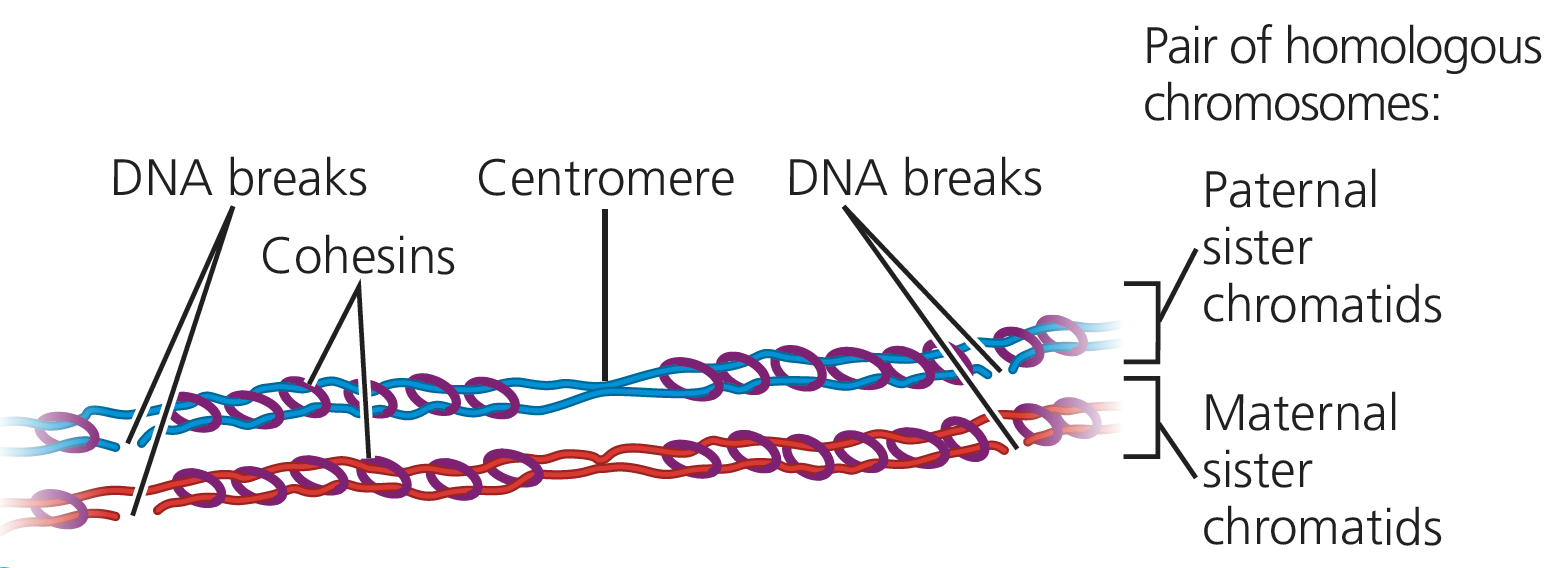
Step 1: Loose Pairing
Key Players
- Cohesin - Protein that holds sister chromatids together
- Homologs pair up loosely and line up gene by gene
- Specific proteins break DNA at matching points on non-sister chromatids (one from each parent)
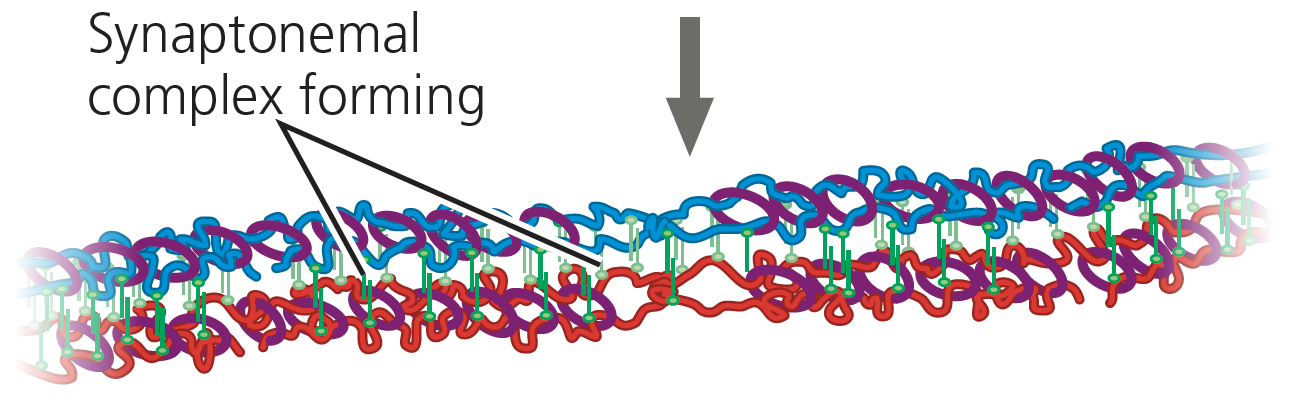
Step 2: Synaptonemal Complex
Synaptonemal Complex
A zipper-like structure that tightly joins the homologs. This process is called synapsis.
Step 3: Crossing Over
What Happens
- DNA breaks rejoin, swapping segments
- When the complex breaks down, chiasmata (X-shaped crossover sites) become visible
Chiasma (plural: Chiasmata)
X-shaped sites where crossing over occurred between non-sister chromatids.
Flashcard Practice
Click each card to reveal the answer - test your memory!
What is a chiasma?
Click to see answer
Chiasma (plural: Chiasmata)
An X-shaped site where crossing over occurred
It's visible when the synaptonemal complex breaks down
This is where DNA was swapped between homologous chromosomes!
What is synapsis?
Click to see answer
Synapsis
The pairing of homologous chromosomes
Mediated by the synaptonemal complex
Brings homologs together for crossing over
What is the synaptonemal complex?
Click to see answer
A Protein "Zipper"
A zipper-like structure that joins homologs together
It holds homologs in close alignment for crossing over
Later breaks down to reveal chiasmata
What is crossing over?
Click to see answer
DNA Exchange
DNA segments swap between non-sister chromatids
Produces recombinant chromosomes
A major source of genetic variation!
What does crossing over produce?
Click to see answer
Recombinant Chromosomes
Crossing over produces recombinant chromosomes
These combine genes from each parent in new combinations
This increases genetic diversity!
THROWBACK
How are daughter cells different in mitosis vs meiosis?
From: Mitosis vs Meiosis
Identical vs Unique
Mitosis: Daughter cells are genetically identical
Meiosis: Daughter cells are genetically unique
Quick Quiz
5. How are daughter cells different in mitosis vs meiosis?
Genetic Variation
Understanding Genetic Variation
Mutations
Changes in an organism's DNA. Mutations are the original source of genetic diversity - they create different versions of genes called alleles.
Key Points
- Mutations create different versions of genes called alleles
- Reshuffling of alleles during sexual reproduction produces genetic variation
- In sexually reproducing species, meiosis and fertilization create most genetic variation
Flashcard Practice
Click each card to reveal the answer - test your memory!
What are mutations?
Click to see answer
Mutations
Changes in an organism's DNA
These are the original source of genetic diversity!
What are alleles?
Click to see answer
Alleles
Different versions of genes
Created by mutations and passed to offspring
What is the original source of genetic diversity?
Click to see answer
Mutations!
Mutations are the original source
They create new alleles that can be inherited
How does sexual reproduction produce variation?
Click to see answer
Allele Reshuffling
Reshuffling of alleles during meiosis and fertilization
Creates new combinations of existing alleles
What is the flow of genetic variation?
Click to see answer
The Flow
Mutations → New Alleles
→ Sexual Reproduction (Meiosis + Fertilization)
→ Genetic Variation
THROWBACK
What are the three unique events in meiosis?
From: Three Unique Events
Three Unique Events
1. Synapsis and crossing over
2. Homologous chromosomes at metaphase plate (as tetrads)
3. Separation of homologous chromosomes
Quick Quiz
5. What are the three unique events in meiosis?
Three Main Sources of Genetic Variation
The Three Sources
Memory Aid
Independent Assortment
Crossing Over
Random Fertilization
1. Independent Assortment
Chromosomes line up randomly in Meiosis I
2. Crossing Over
Genes are swapped between homologous chromosomes
3. Random Fertilization
Any sperm can fertilize any egg
Flashcard Practice
Click each card to reveal the answer - test your memory!
What are the three sources of genetic variation?
Click to see answer
ICR - The Three Sources!
Independent Assortment - Chromosomes line up randomly
Crossing Over - Genes are swapped between homologs
Random Fertilization - Any sperm can fertilize any egg
What is independent assortment?
Click to see answer
Random Chromosome Orientation
Chromosomes line up randomly during Metaphase I
Each pair sorts independently of other pairs
Creates many possible combinations!
What is crossing over?
Click to see answer
Gene Swapping
Genes are swapped between homologous chromosomes
Produces recombinant chromosomes
Happens during Prophase I
What is random fertilization?
Click to see answer
Any Sperm + Any Egg
Any sperm can fertilize any egg
Multiplies the variation from independent assortment
Results in enormous genetic diversity!
What does ICR stand for?
Click to see answer
Three Sources of Variation
Independent Assortment
Crossing Over
Random Fertilization
THROWBACK
What is a chiasma?
From: Synapsis & Crossing Over
Chiasma (plural: Chiasmata)
An X-shaped site where crossing over occurred
Visible when synaptonemal complex breaks down
Quick Quiz
5. What is a chiasma?
Independent Assortment of Chromosomes
How Independent Assortment Works
Key Mechanism
- Homologous pairs of chromosomes orient randomly at metaphase I
- Each pair of chromosomes sorts maternal and paternal homologues into daughter cells independently of the other pairs
The Formula
Number of combinations possible when chromosomes assort independently into gametes = 2n, where n = haploid number
Flashcard Practice
Click each card to reveal the answer - test your memory!
How many chromosome combinations are possible?
Click to see answer
Over 8 Million from ONE Parent!
Formula: 2n where n = haploid number
For humans (n=23): 2^23 = 8,388,608 combinations!
And that's just from ONE parent!
What is the formula for chromosome combinations?
Click to see answer
2^n
Formula: 2^n where n = haploid number
This gives the number of possible chromosome combinations from independent assortment
For humans (n=23): 2^23 = 8,388,608
When does independent assortment occur?
Click to see answer
Metaphase I
Independent assortment occurs during Metaphase I
Homologous pairs orient randomly at the metaphase plate
Each pair sorts independently of other pairs
What does independent assortment mean?
Click to see answer
Random Orientation
Each homologous pair sorts independently of other pairs
Maternal and paternal homologs randomly face each pole
Creates 2^n possible combinations!
Does independent assortment apply to genes on the same chromosome?
Click to see answer
NO!
Independent assortment only applies to different chromosome pairs
Genes on the same chromosome are linked
They tend to be inherited together (unless crossing over separates them)
THROWBACK
What does ICR stand for?
From: Sources of Variation
Three Sources of Genetic Variation
Independent Assortment
Crossing Over
Random Fertilization
Quick Quiz
5. What does ICR stand for?
Random Fertilization
The Final Source of Variation
Random Fertilization
Any sperm can fuse with any ovum (egg).
The Numbers
- Fusion of two gametes (each with ~8.4 million possible chromosome combinations from independent assortment)
- Produces a zygote with any of about 70 trillion diploid combinations!
Egg: ~8.4 million combinations (2^23)
Zygote: ~70 TRILLION combinations!
Complete Summary
Final Memory Aid
Mix up genes (crossing over + independent assortment + random fertilization)
Half the chromosomes (2n n)
Flashcard Practice
Click each card to reveal the answer - test your memory!
How many zygote combinations are possible?
Click to see answer
~70 TRILLION!
Sperm (8.4 million) × Egg (8.4 million) = ~70 TRILLION combinations
And this doesn't even count crossing over!
Every human (except twins) is genetically unique!
What is random fertilization?
Click to see answer
Any Sperm + Any Egg
Any sperm can fuse with any egg
This random fusion multiplies genetic variation
How many combinations from one parent's independent assortment?
Click to see answer
~8.4 Million
Each parent produces gametes with ~8.4 million possible combinations
Formula: 2^23 = 8,388,608
And that's BEFORE fertilization!
What is the final calculation for human zygote combinations?
Click to see answer
8.4 Million × 8.4 Million
Sperm: ~8.4 million combinations (2^23)
Egg: ~8.4 million combinations (2^23)
Zygote: ~70 TRILLION combinations!
Why are no two humans (except twins) genetically alike?
Click to see answer
Three Sources Combined!
Independent assortment (~8 million per parent)
+ Crossing over (even more variation)
+ Random fertilization (multiplies everything)
The odds of identical genetics are essentially ZERO!
THROWBACK
What is the 2^n formula for?
From: Independent Assortment
Chromosome Combinations
Formula: 2^n where n = haploid number
For humans: 2^23 = 8,388,608 combinations from one parent!
Final Quiz
5. What is the 2^n formula for?